Pool Repair
Pumps, filters, heaters, valves and plumbing — found and fixed by technicians who know what they are looking at.
- Pump & motor repair
- Filter repair
- Valves & plumbing
Family-owned since 1982. BBB accredited since 2003.
Monday – Friday, 8:00 AM – 5:00 PM · Spring, TX

Losing more water than evaporation? We find pool leaks in Spring and North Houston — in the shell, light niches, skimmers, plumbing under the deck and the equipment pad — by testing, not guessing, and then repair them.
Call Us NowGet a free estimate
Request received
Thank you — we reply during office hours, Monday – Friday, 8:00 AM – 5:00 PM. Urgent? Call (832) 528-4979.
 BBB ratingA+ ratedAccredited since 2003 →
What is included
Every Houston pool loses water in August — an inch or more a week to evaporation is normal when it is 98 degrees with a breeze. The question is whether yours is losing more than that. Leak detection starts by proving there is a leak at all, then narrows it down: the shell, a light niche, a skimmer throat, the plumbing under the deck or the equipment at the pad. One of our customers wrote that we found the leak after others had failed for hours. That is the job — patient, methodical elimination, not pumping dye in the deep end and guessing.
Leaks traced in plumbing, fittings and the shell, then repaired — including the ones other companies missed.
A controlled bucket test and water-loss readings with the pump on and off. It separates evaporation from a leak, and suction-side from pressure-side plumbing.
Dye testing around light niches, skimmer throats, returns, main drains and any visible cracks — the places water most often escapes a concrete pool.
Pressure-testing the lines one at a time to find which pipe is losing water, before anyone breaks out a deck.
Pump seals, filter clamps, valve stems and unions. Some of the leaks we are called for are dripping in plain sight behind the fence.
Fittings resealed, light niches and skimmers repaired, cracks patched and lines fixed — or, where a shell has deeper problems, an honest conversation about replastering.
What we tested, what we found and where. Useful for your records, and for an insurer if water has damaged something else.
Why people call us
How it works
Timing. Leak calls peak in June and July, when evaporation makes every pool look like it is leaking. A bucket test in spring gives a cleaner answer.
You run a bucket test for a couple of days, or we set one up. The numbers tell us whether it is a leak and roughly where to look.
The cheap, visible places are checked before anything invasive — pad plumbing, skimmers, lights and returns.
If the loss follows the pump running, each line is isolated and tested until the failing one shows itself.
Once located, we quote the repair. Small fixes are often done the same visit; line repairs under decking are scheduled.
Water loss is measured again after the repair. A leak is not fixed until the level stops dropping.
What it costs
$400 – $600 to locate
Leak detection on a residential pool runs $400–$600, depending on the pool. The repair is priced separately once we know what it is: sealing a light niche or skimmer is a small job, while a broken line under a deck involves cutting and patching concrete and costs more. We tell you where the leak is before you commit to fixing it.
Starting prices. Your exact price is confirmed in writing before any work starts.
We come out, look at the pool and give you a written price. No charge and no obligation.
Owner Brian supervises each project. You can reach the people who run the company, not a call centre.
We diagnose before we sell, and tell you when something is a simple fix you could do yourself.
Accredited by the Better Business Bureau for more than twenty years, and family-owned since 1982.
In their words
Real Google reviews, unedited — the ones where the customer mentioned this kind of work.
Jeffrey Nelson
June 2025
Bought new house near Tupelo Park Jan 2025, Brian has been helping me with pool issues since I moved in. New pump, new chlorinate, new robo vacuum, fixed various leaks, repaired broken valve piece, and helped me reprogram my controller for new pool affects with the water features. Half of this stuff he did for me while I was on vacation and threw in a pool cleaning too too. 5-stars for sure. Super responsive, delivers what he says he will.
Jay Coons
December 2024
Had been losing pool water for over six (6) months ~ Couldn’t find a leak so I replaced the multiport valve gasket; that wasn’t it ~ Got frustrated and called in “professionals” ~ Two (2) came, didn’t have a clue and left. Called Aloha Swimming Pools, Inc. and didn’t leave a message, because Chris actually picked up the phone ~ Said he’d check when they had a tech in the area and would advise when they could come and evaluate the issue(s) ~ About an hour later I heard a vehicle in my drive and it was Chris and his helper. Chris inspected the equipment while the helper checked the pool ~ The helper found a leaking pipe in the water feature buried waaaaaay in the back of the pool area under dense vegetation ~ The helper capped the pipe and Chris found and replaced a faulty water feature valve. And they were done and I haven’t added a drop of water to the pool since ~ Yes, it was a simple fix, but I darn sure couldn’t find it ~ The “big deal” is the customer service I received; that’s exactly how a service provider should operate their business and I couldn’t have asked for more or better. Aloha Swimming Pools, Inc. is my new pool service provider and if I have a future issue I cannot repair myself, I'll be calling them ~ Try them out!
Where we do it
Before you call
Something not answered here? Call (832) 528-4979 — we would rather talk it through than have you guess.
Do the bucket test. Put a bucket on the pool step, fill it to match the pool level, and mark both water lines. After 24 to 48 hours with no rain or splashing, compare the drop — if the pool has fallen noticeably more than the bucket, you have a leak. Run it once with the pump on and once with it off; the difference tells us whether the leak is in the pressurised plumbing. Our blog has a step-by-step version.
In the height of a Houston summer, a quarter of an inch a day to evaporation is common, and more on windy days or if you run a water feature or heater. In winter it drops sharply. If you are losing more than about half an inch a day consistently, or the loss stays high on cool, still days, something is leaking. The bucket test turns that suspicion into a number.
It can. Water leaving a pool has to go somewhere, and in our clay soils it can soften the ground under a deck, undermine a slab edge or cause settlement. Plumbing leaks also keep diluting the pool chemistry, so algae keeps coming back. It is one of the few pool problems that gets more expensive the longer it is left, which is why we recommend testing as soon as the loss looks wrong.
Sometimes, but only a section, and only after the line has been pressure-tested so we know which pipe and roughly where. Many leaks turn out to be at fittings, lights or the equipment pad and need no concrete work at all. When a line under the deck has failed, we cut the smallest practical access, repair the line and patch the concrete, and explain beforehand what it will look like afterwards.
We come out, look at the pool properly, and put a written price together before any work starts.
Related services
Pumps, filters, heaters, valves and plumbing — found and fixed by technicians who know what they are looking at.
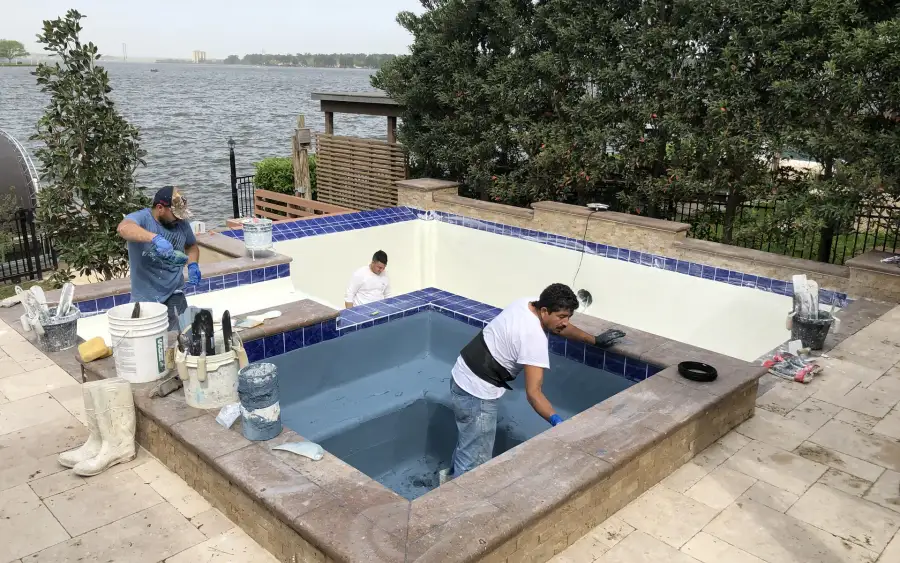
Stained, rough or cracked plaster stripped back and refinished in white, colored or aggregate finishes.
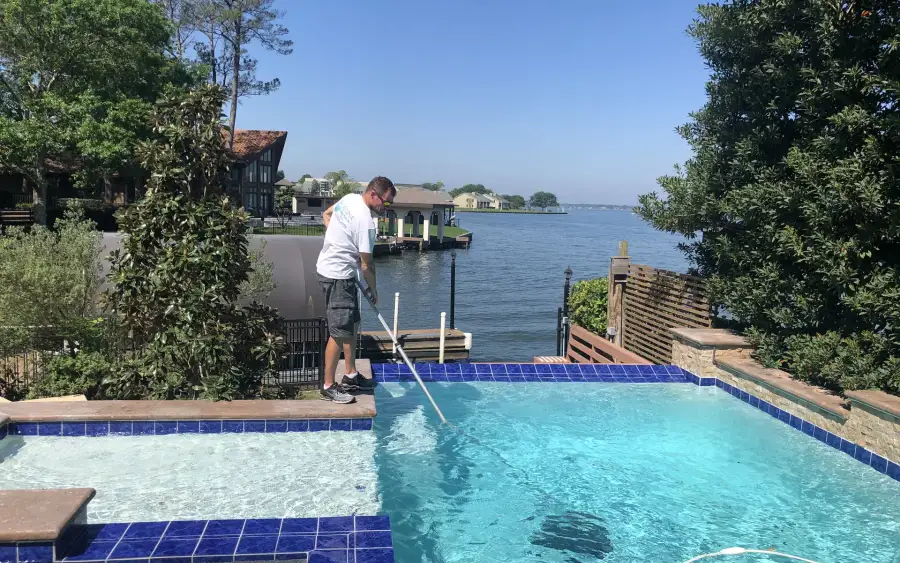
Brushed, vacuumed, balanced and checked every week — with a service report after each visit.